

매일 반복하는 수출 업무,
하나부터 자동화해 드립니다.Automate your daily export work,
one workflow at a time.
제 수출 실무 경험을 담아, 귀사의 업무 방식에 맞는 자동화를 만들어 드립니다.
Drawing on my years on an export desk, I build automation around the way your team already works.
올해 함께 시작하는 한두 회사의
첫 모듈은 비용을 받지 않고 만들어 드리겠습니다.
This year, I’ll build one workflow at no charge for one or two companies.
최근 선사 안내 없던 부킹 127건의 컷오프 바로잡음127 unannounced cut-off changes corrected in a month 부킹 4,461건 처리4,461 bookings processed 자동 처리 업무 50종50 jobs running on their own







01 · 반복 업무에 낭비되고 있는 시간과 비용
01 · The time and money wasted on repetitive work
포워딩 업무에서 매일 반복되며 시간을 빼앗는 세 가지.
Three everyday tasks that eat up time in forwarding.
같은 값을 서류에서 시트로, 시트에서 메일로 하루 수십 번 옮겨 적습니다.
The same value, moved from document to sheet to email — dozens of times a day.
숫자 한 자리의 오류가
B/L, 수출신고, 정산까지 그대로 이어집니다.
One wrong digit carries straight through to the B/L, the filing and the invoice.
다섯 곳을 확인하느라 회신이 늦어집니다.
While you search five places for the answer, the customer waits — and trust slips.
옮겨 적기 · 서류 대조 · 진행 상황 확인을 자동화가 대신합니다.
Re-keying, document checks and status updates — all automated.
02 · 그래서, 자동화에게 맡겼습니다
02 · So I handed it to automation
미국 포워딩 현장 7년 — 수출 데스크의 반복 업무를 하나씩 자동화해 왔습니다.
지금은 자동화 시스템을 통해 전체 업무를 처리하고 있습니다.
Seven years at a US freight forwarder, automating the export desk’s repetitive work one piece at a time.
Today the automation runs the desk’s entire workload.
미국 수출 포워더의 실제 운영 시스템에서 측정한 수치 · 2026년 9월 기준
Measured from a system in daily production at a US export forwarder · Sep 2026
수출 데스크의 하루, 자동화 전과 후.
A day on the desk, before and after.
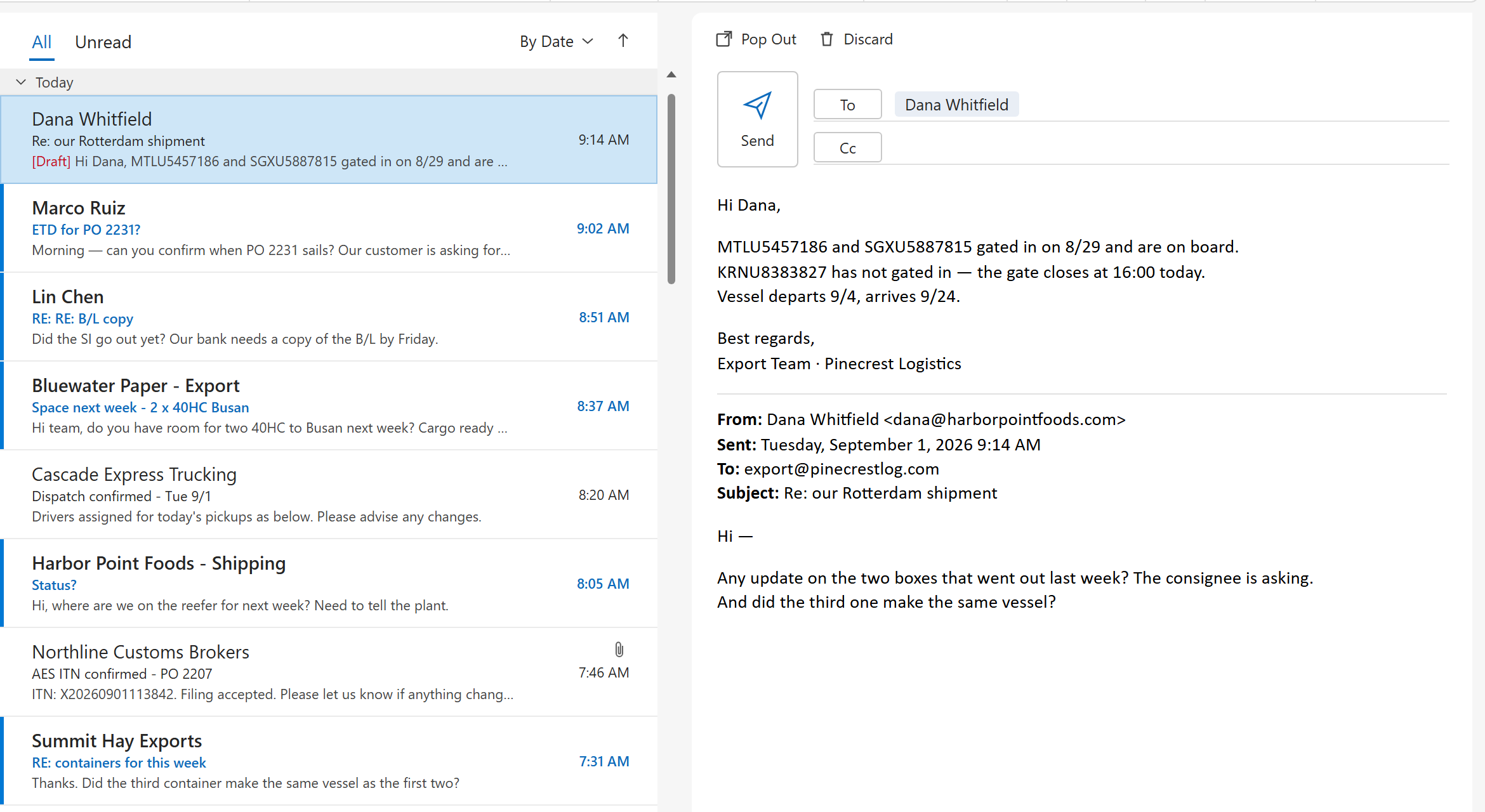
Draft B/L 3건 · 값 201개 대조Checking 201 values on three draft B/Ls
「지금 어디까지 됐나요?」 회신Answering “any update?”
03 · 자동화가 업무를 처리하는 과정
03 · How the automation handles the work
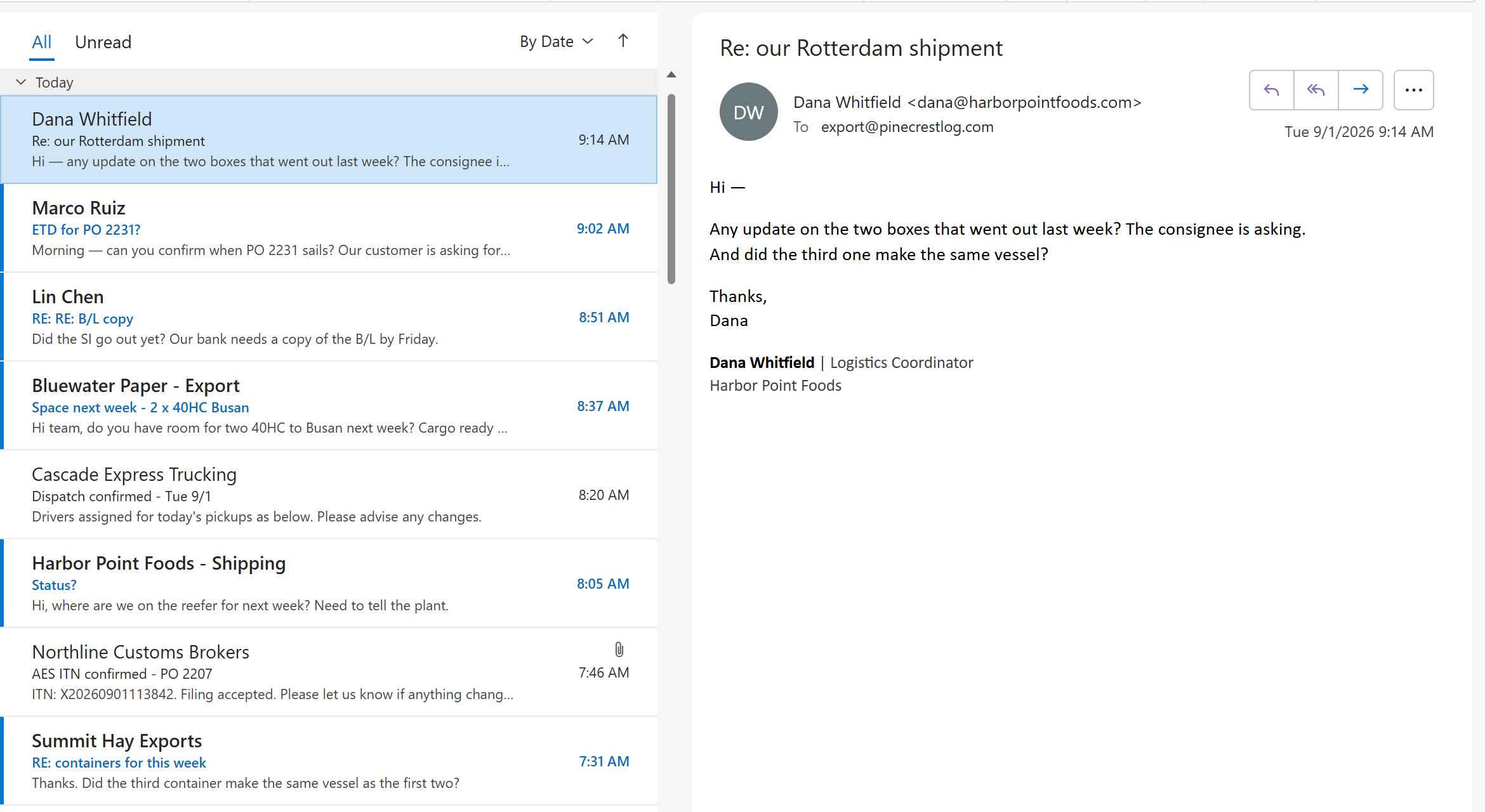
「지금 어디까지 진행됐나요?」
답을 찾고 회신하는 데 30분이 걸립니다.
"Any update?" — the question that costs your desk thirty minutes.
빠른 회신은 고객의 신뢰로 이어집니다. 여러 곳에 흩어진 정보를 문의가 오기 전에 자동으로 모아 둡니다.
In logistics, fast answers build trust. The answer is already there — it’s just spread across several systems. The automation pulls it together before the question even arrives.
하루 50~200통 중 한 통
One of 50–200 a day
고객이 문의합니다
A customer asks
참조번호 없이 문의만 적힌 짧은 메일입니다. 어디를 확인해야 답할 수 있는지는 담당자만 알고 있습니다.
No form, no reference number — a single line of text.
And the only person who knows where to look is the one already handling everything else.
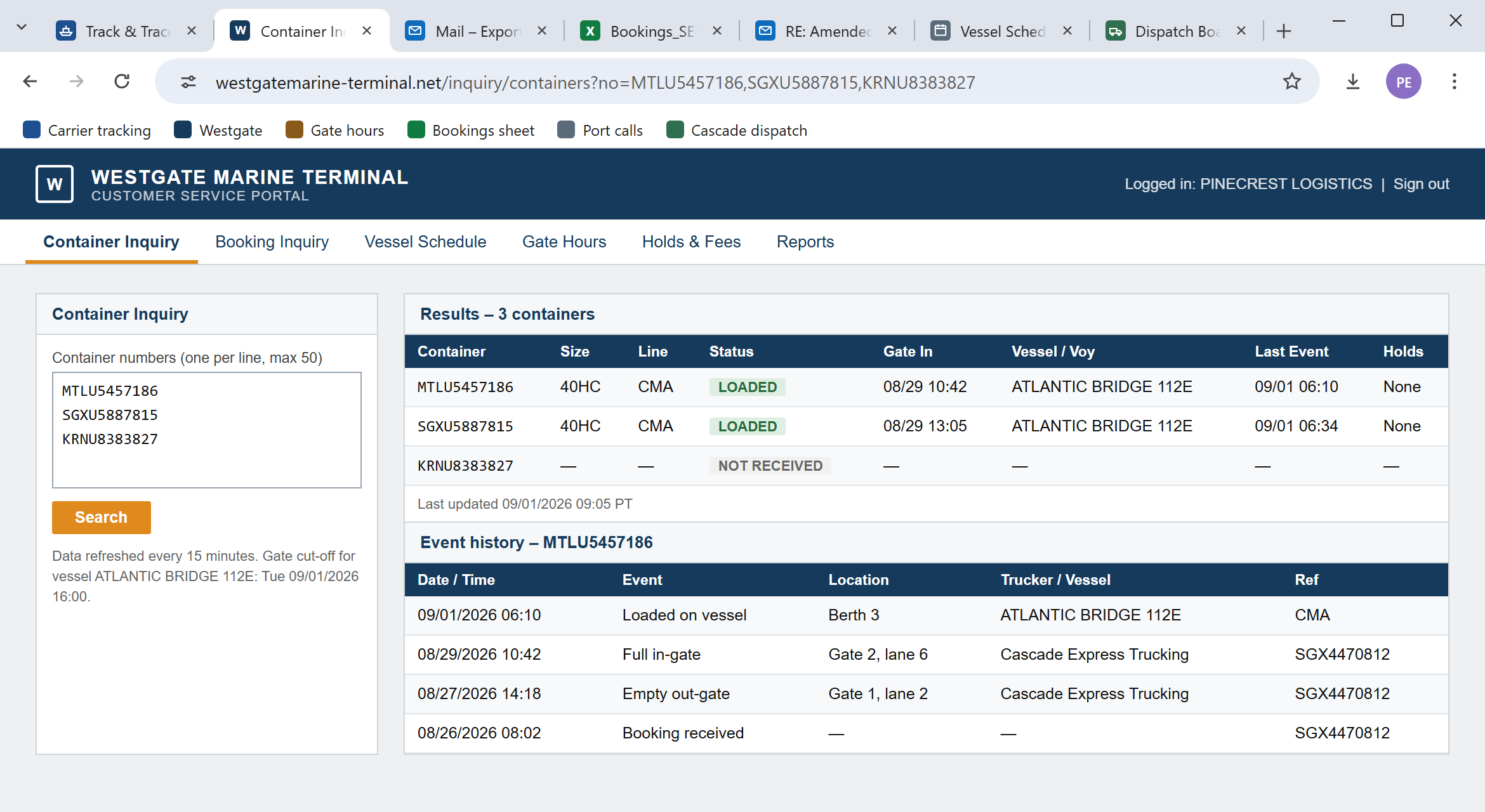
건당 10~15분
10–15 minutes each
담당자가 여러 곳을 확인합니다
The answer sits in several different places
어느 한 곳에서 풀 수 있는 문제가 아닙니다. 선사 사이트와 터미널 사이트를 확인하고, 트럭커 메일을 찾고, 관리 시트와 이전 스레드까지 확인한 후에야 회신을 작성할 수 있습니다.
No single source holds the complete answer. You check the carrier site, then the terminal site, search for the trucker's email, open the sheet, find the thread where the booking was amended — and only then write the reply.
문의가 오기 전부터, 하루 종일
Before anyone asks, all day long
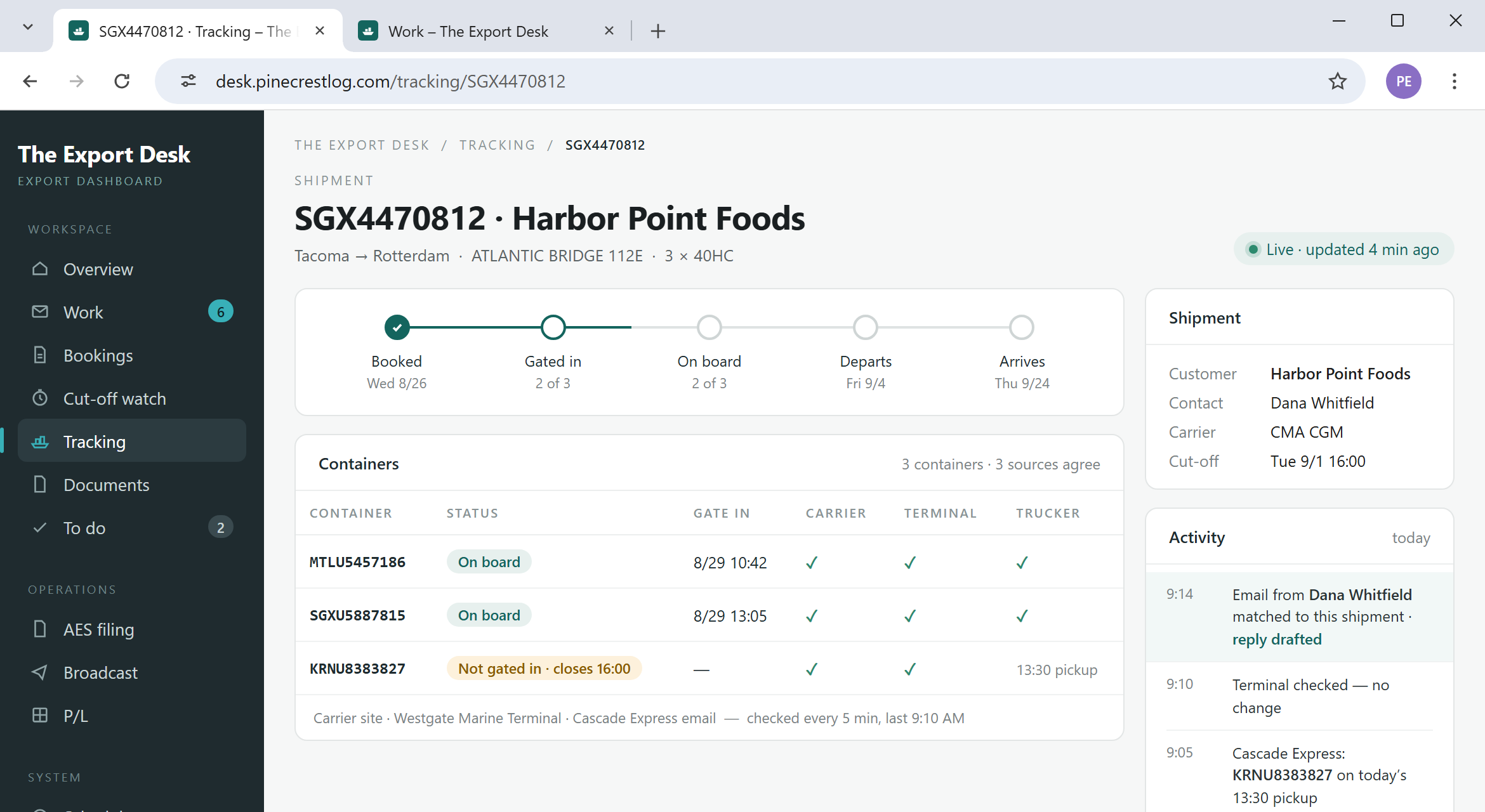
시스템이 미리 모아 둡니다
It is already in one place
시스템은 다섯 곳의 소스를 하루 종일 순회하며 정보를 한곳에 취합합니다. 검색에 쓰이던 시간이 사라지고, 소스 간 불일치가 있으면 함께 표시됩니다.
The system polls all five sources throughout the day and keeps the answer in one place. The time spent looking things up disappears — and if two sources disagree, that is flagged too.
이 단계 없이는 어떤 것도 발송되지 않습니다
Nothing goes out without this step
사람이 검토하고 발송합니다
A person reviews and sends
회신은 이미 작성되어 있습니다. 수정하거나 폐기할 수 있습니다. 그리고 고객이 묻지 않은 사항 — 아직 반입되지 않은 세 번째 컨테이너 — 까지 함께 표시됩니다.
The reply is already drafted. Send it, edit it, or discard it.
The draft also flags an issue the customer didn’t ask about: the third container hasn’t gated in yet.
업계 조사에 따르면 포워딩 데스크는 하루 50~200통의 고객 메일을 처리하며, 메일 업무만으로 근무시간의 최대 30%가 소요됩니다. 실제로는 상태 문의 한 건을 찾아보고 회신하는 데 30분 정도가 걸립니다.
Industry surveys place a forwarding desk at 50–200 customer emails a day, with email alone consuming up to 30% of working hours. In practice, a single status inquiry takes about thirty minutes to look up and answer.
차별화된 모듈 시스템
Modular by design
부킹부터 수출신고까지, 업무별로 자동화합니다.
One shipment, start to finish — each stop is a module.
반복 업무가 가장 많은 부분부터 시작할 수 있습니다.
Start with the stop where the most repetitive work piles up.
04 · 직접 확인하세요
04 · See it run
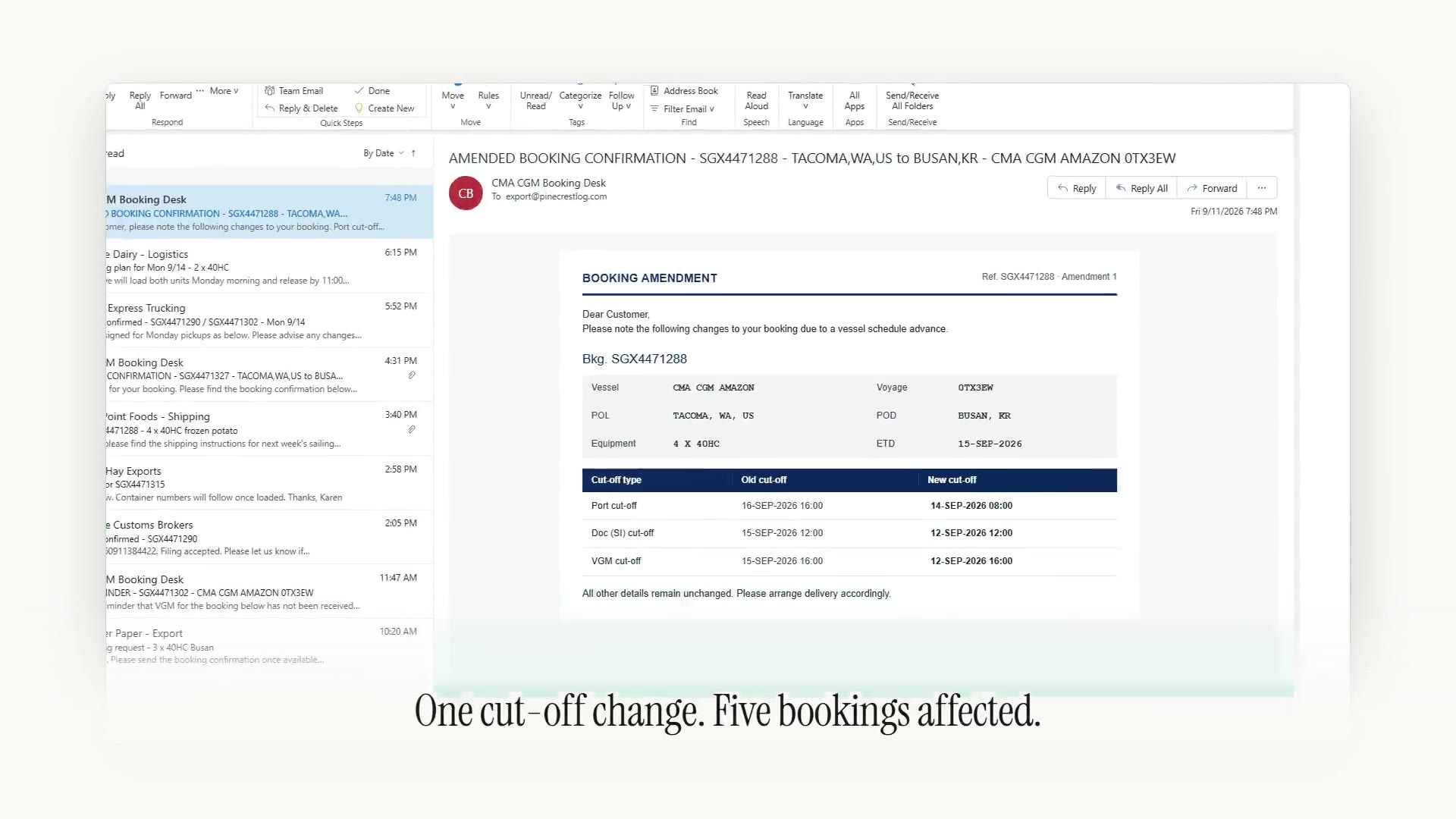
선사가 컷오프를 바꿉니다.
자동화가 업무를 처리하고, 담당자는 확인 및 승인만 합니다.
The carrier moves a cut-off.
The automation does the work — you just review and approve.
부킹 다섯 건 수정, 메일 여섯 통 작성. 승인 한 번이면 모두 나갑니다.
Five bookings updated, six emails drafted. One tap sends them all.
실제 사례
Real cases
휴먼에러는 언제든 발생할 수 있습니다.
실제 업무에서 생긴 문제 네 가지.
Human error can happen at any time.
Here are four real cases.
무슨 일이 있었고, 자동화가 어떻게 처리하는지 확인해 보세요.
See what happened on the desk — and how automation handles each one.
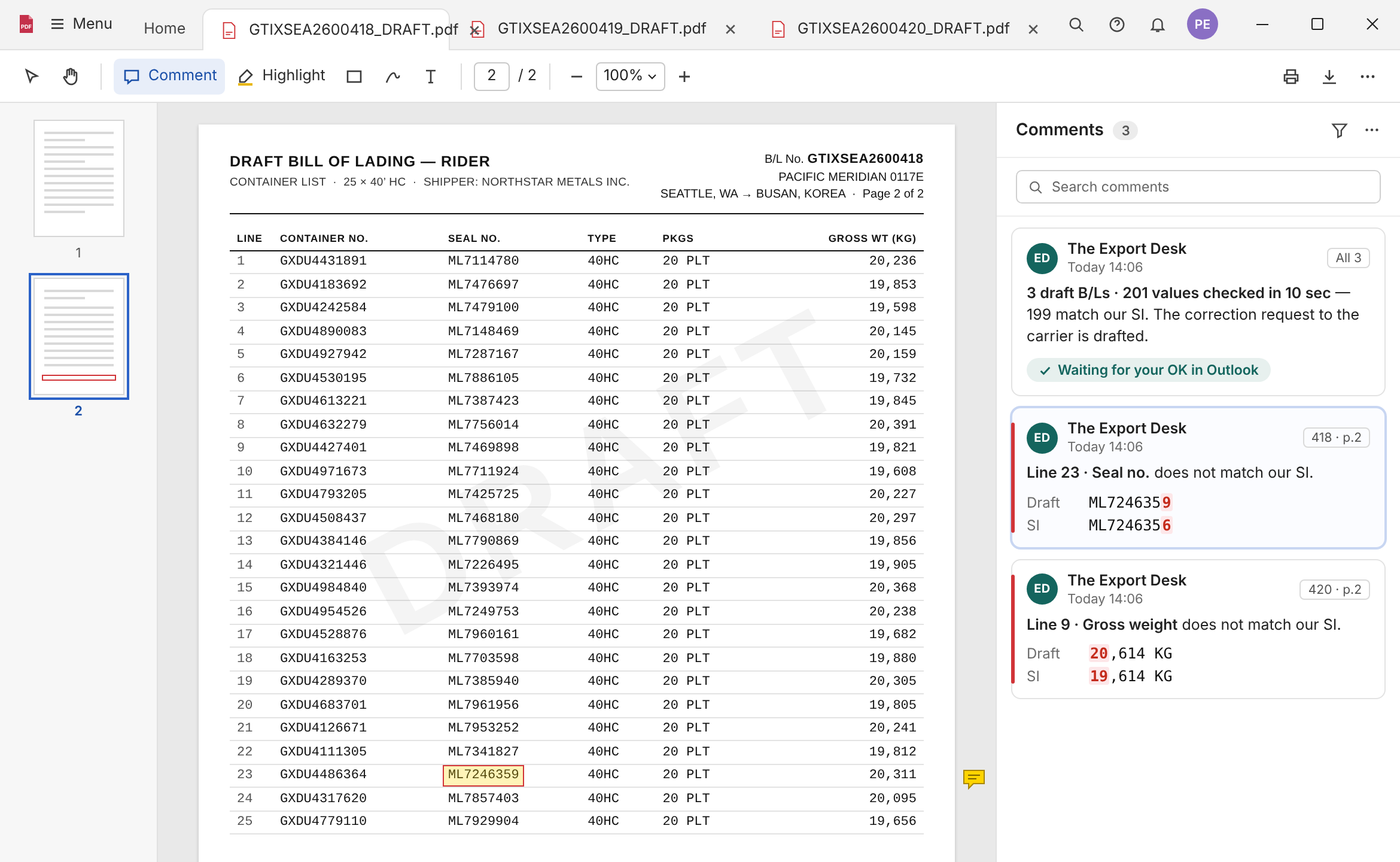
B/L 3건, 컨테이너 67개, 대조 항목 201개
Three B/Ls, 67 containers, 201 values to check
수작업으로 20분이 걸렸지만, 오류 2건을 잡아내지 못했습니다. 자동화는 10초 안에 모든 항목을 대조하고, 선사에 보낼 정정 요청 메일까지 작성해 둡니다.
Twenty minutes by hand — and two errors still got through. The automation checks every value in ten seconds, with the correction email to the carrier already drafted.
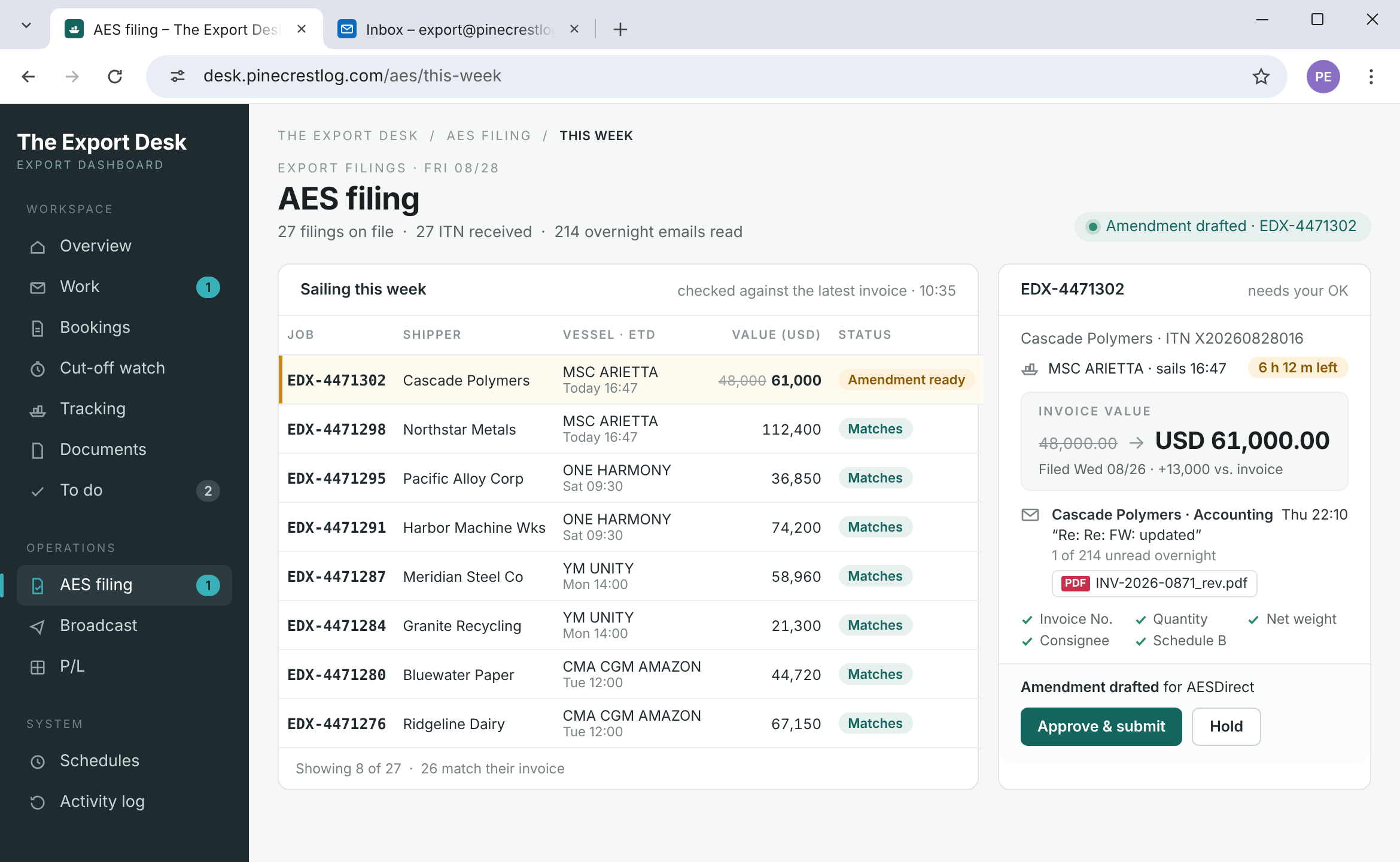
수출신고 금액이 틀린 채 출항할 뻔했습니다
The cargo almost sailed with the wrong value
화주가 목요일 밤에 보낸 수정 invoice가 읽지 않은 메일 214통 사이에 묻혔습니다. 수출신고는 이미 옛 금액으로 나간 뒤였고, 출항까지 여섯 시간 남아 있었습니다.
An amended invoice came in Thursday night and got buried under 214 unread emails. Six hours before departure, the export filing still showed the old value.
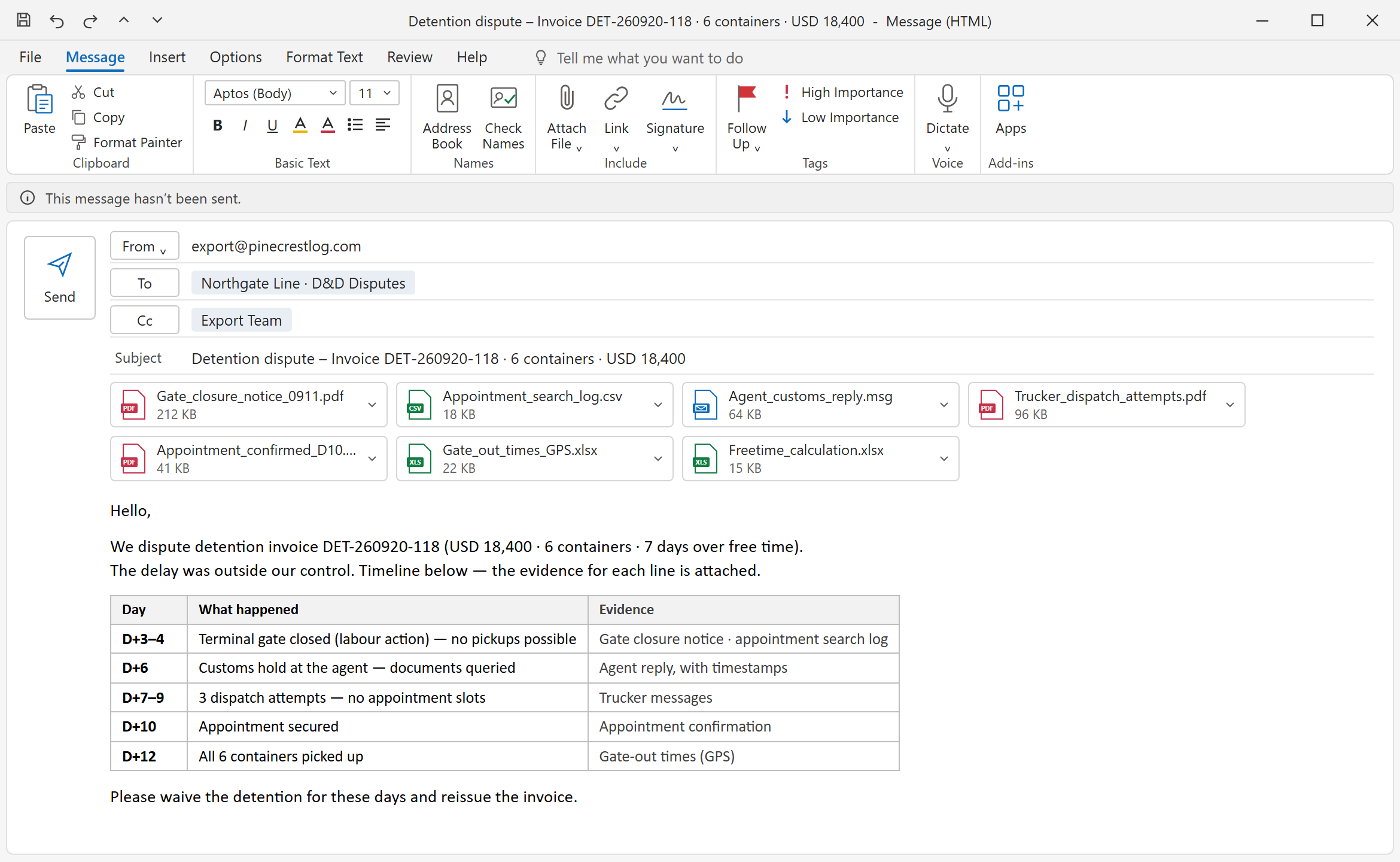
증거가 흩어져 있습니다
Not the company’s fault — and no proof of it
터미널이 2일 닫혔고 통관도 늦어, 선사가 detention $18,400를 청구했습니다. 회사 잘못이 아니라는 증거는 메일함·대리점 스레드·메신저·로그 네 군데에 흩어져 있었습니다.
The gate was shut for two days and clearance ran late — and the carrier billed
$18,400 in detention.
The proof it wasn’t us sat scattered across an inbox,
a broker’s email thread, text messages and a system log.
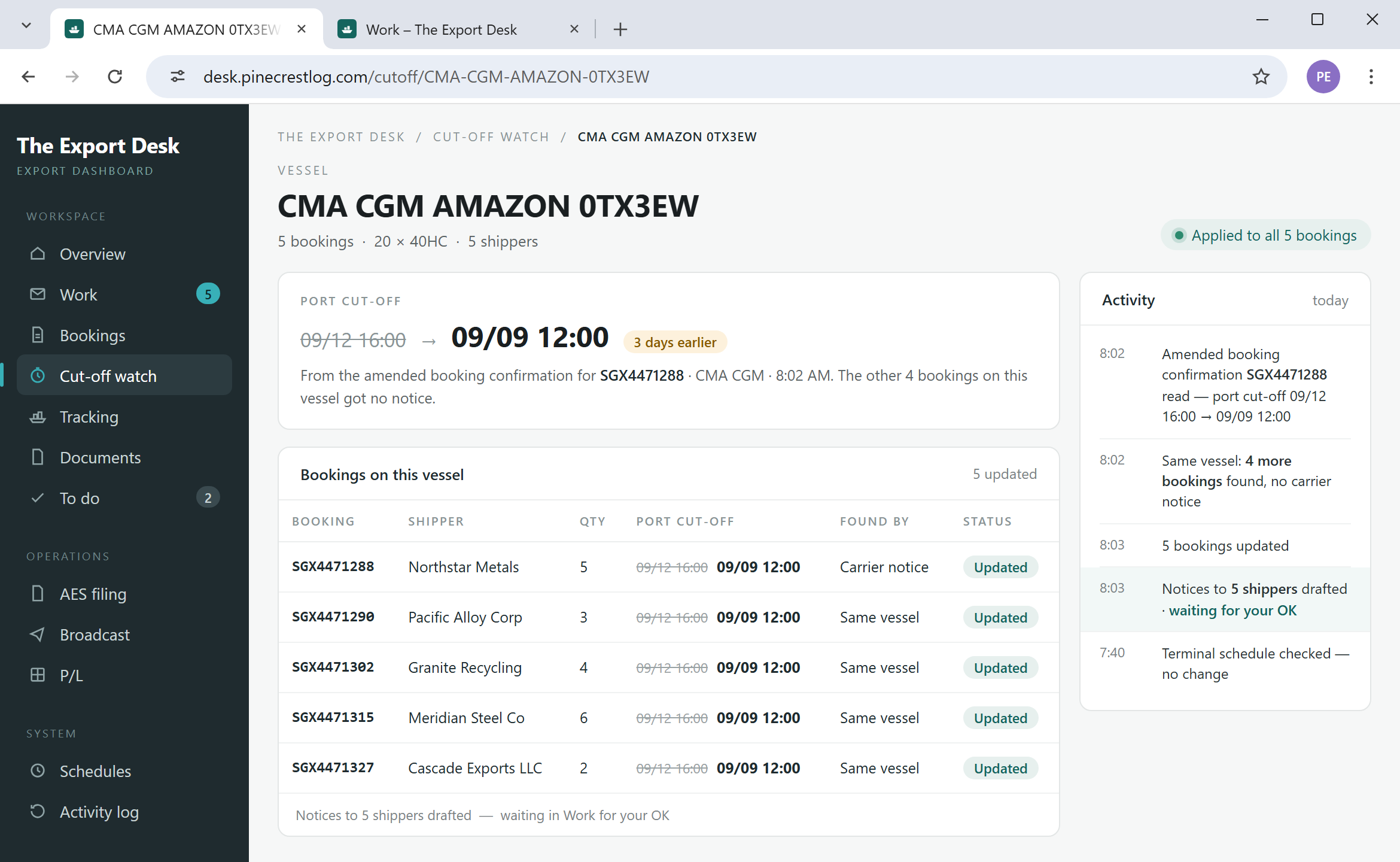
같은 배의 부킹 다섯 건 중 한 건에만 변경 안내가 왔습니다
The schedule-change notice named just one of the bookings
마감이 사흘 앞당겨졌는데 통지에는 부킹번호 하나뿐이었습니다. 나머지 네 건을 놓쳤다면 마감 변경이 고객에게 전달되지 않아, 그대로 큰 손실로 이어질 뻔했습니다.
The cut-off moved in by three days, and the notice carried a single booking number. Had the other four been missed, those customers would never have heard — and the loss would have been serious.
05 · 운영 원칙
05 · Operating principles
자동화를 100% 믿을 수 없다는 것, 현직자로서 누구보다 잘 압니다.
그래서 마지막 결정은 반드시 담당자의 손에 남겨 두었습니다.
Having done this job myself, I know automation can never be trusted 100%. So the final decision always stays in the operator’s hands.
작업은 자동화가, 결정은 사람이 합니다.
The automation does the work. The decision stays with a person.
자동화The automation
- 선사 서류를 전부 읽습니다Reads every carrier document누적 922건922 documents to date
- 값 하나하나를 요청과 대조합니다Checks each value against the requestDraft B/L 누적 585건585 draft B/Ls to date
- 같은 배의 부킹을 모두 고칩니다Updates every booking on the vessel30일 542건542 fixes in 30 days
- 마감을 밤낮으로 지켜봅니다Watches cut-offs day and night30일 변경 1,052건1,052 changes in 30 days
- 고객·trucker 메일 draft를 작성합니다Drafts the customer and trucker emails30일 통보 961건961 notices in 30 days
- 제출 직전에 화면을 다시 읽습니다Double-checks the screen before submittingSI 누적 209건209 SIs to date
- 확실하지 않은 건 담당자에게 넘깁니다Hands you anything it isn’t sure of
- 작업이 멈추면 스스로 알립니다Alerts you if a job stops누적 494건494 alerts to date
- SI 발송 · HMMSI sent · HMM
- 야드 2곳에 안내 발송2 yard notices sent
- 부킹 기록 업데이트Booking record updated
자동화 업무 처리 후 담당자의 확인을 받습니다.
Once the work is done, it waits for your approval.
모니터링은 독립적으로 운영됩니다. 자동화 시스템과 이를 검사하는 시스템이 분리되어 있어, 한쪽이 멈추면 다른 쪽이 알립니다.
Monitoring runs on its own. The automation and the system that watches it are separate — if either one stops, the other tells you.
06 · Freight Forwarder 현직자의 경험으로 만든 시스템
06 · Built from a forwarder’s first-hand experience
개발 회사에 맡기는 것과 무엇이 다른가요?
How is this different from hiring a software company?
미국 포워딩 회사에서 7년 일한 사람이 직접 만듭니다.
Built by someone with seven years at a US freight forwarder.
07 · 작은 시작, 큰 결실
07 · Start small, grow from there
처음부터 완벽하게 시작하지 않습니다 — 작게 시작해, 검증하며 넓혀 갑니다.
We test one workflow in daily use first, then add more.
가장 부담이 큰 업무 하나부터 검증합니다.
Start by automating your most demanding task.
효과가 가장 빠르게 확인되는 모듈 하나를 실제 업무에 적용해 결과를 확인하신 후, 확장 여부를 결정하시면 됩니다.
One module, the one with the fastest payback, goes live first; you judge the results before anything further is built.
첫 모듈 정하는 미팅Meeting to pick your first workflow
업무 흐름을 함께 보고, 첫 모듈로 만들 업무를 정합니다.
We walk through your workflow and pick the one to build first.
파일럿Pilot2~4주2–4 wks
모듈 1개를 실제 업무에 적용하고, 결과를 함께 확인합니다.
One module goes live, and we review the results together.
모듈 확장Expansion모듈당 2~4주2–4 wks each
검증된 뒤에만 모듈을 하나씩 추가합니다. 각 단계는 사전 승인 후 진행됩니다.
Modules are added one at a time, only after proof — each step approved in advance.
운영·유지보수Operations지속ongoing
선사·고객의 포맷 변경에 대응하고, 새로운 예외를 반영하며, 지속적으로 개선합니다.
I handle format changes, new exceptions, and ongoing improvements.
Pilot
올해 함께 시작하는 한두 회사는
첫 모듈 제작 비용이 없습니다.
This year, I’ll build one workflow at no charge for one or two companies.
- 가장 부담이 큰 업무 하나를 자동화
- Your toughest task, automated
- 결과가 만족스럽지 않으면 여기서 종료 가능
- Stop here if the results do not convince you
기존 시스템은 그대로, 업무 중단 없이 진행됩니다.
파일럿 기간에도 데스크는 평소처럼 돌아갑니다.
Your system stays as it is.
Your team works as usual throughout the pilot.